What is the best way to choose portafilters, baskets, and tampers for a luxury machine?
The parts that touch the coffee cost a fraction of the machine and shape every shot. Here is how to choose them with the same care as the boiler.
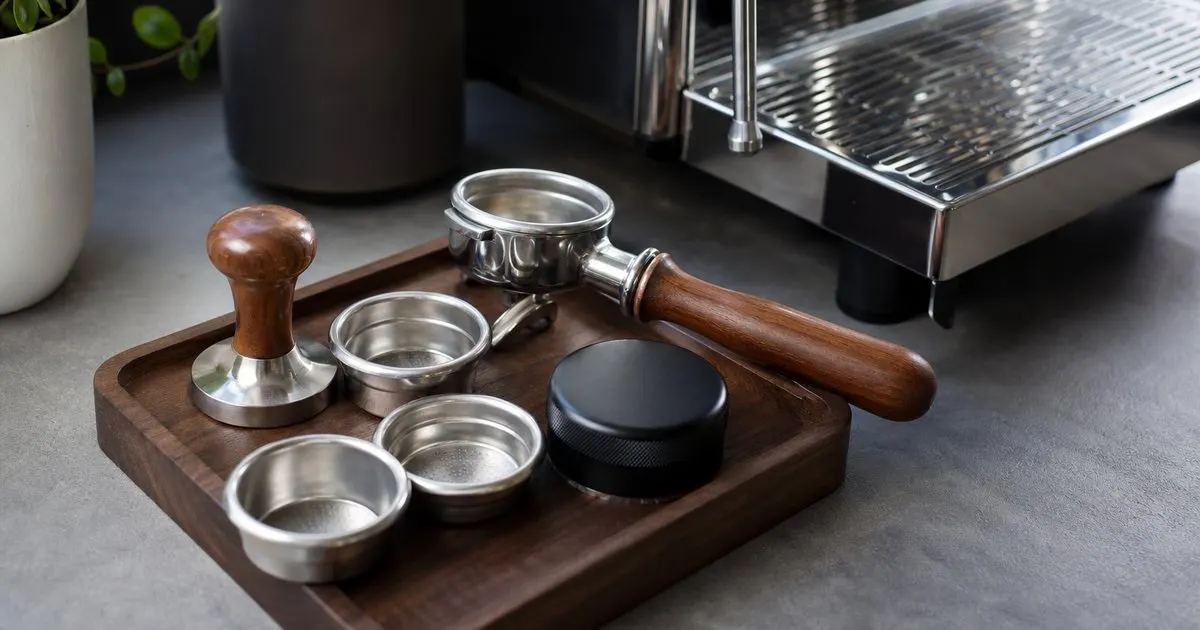
Know your group size before buying anything
Portafilters and baskets are sized to the group head, and the most common diameter on prosumer and commercial machines is fifty eight millimeters, though several respected manufacturers use fifty three or fifty four millimeter groups and a few use other sizes entirely. Within the fifty eight millimeter world there are still small variations in basket wall geometry and portafilter ear spacing, so accessories marketed as universal do not always seat perfectly. Confirm the exact diameter and, where possible, buy baskets and tampers designed for your machine or measured against it. Related: What actually separates a prosumer espresso machine from an everyday home model?
A machine on a widely used standard group gives you the richest choice of third party baskets, tampers, and distribution tools. That is a legitimate factor when choosing between two otherwise similar machines. A proprietary size will still make excellent coffee, but you will buy accessories from a shorter list, often at higher prices, and you will wait for the manufacturer to adopt new basket designs rather than trying them the week they appear. Related: How important is a dual boiler when choosing a luxury espresso machine?
Keep reading: What actually separates a prosumer espresso machine from an everyday home model?, How important is a dual boiler when choosing a luxury espresso machine?, Should you pair your espresso machine with a separate high end grinder?. See how Cremaholm helps you a connoisseur guide to prosumer and luxury espresso machines.
Precision baskets and why they matter
The stock basket that ships with most machines is adequate, but precision baskets, which are manufactured with tighter tolerances on hole size, hole placement, and the flatness of the base, extract more evenly. The visible effect is fewer spurts and channels from a bottomless portafilter and a more consistent shot time from dose to dose. Precision baskets also come in a range of capacities and hole patterns, and each behaves slightly differently, so the grinder often needs a small adjustment when you switch.
Choose a basket capacity that suits how you actually dose. A basket designed around eighteen grams will not perform at its best with fourteen, and overfilling a small basket leaves the puck touching the shower screen. Own two: one for your daily dose and a smaller or larger one for experimenting. Baskets with a fine mesh insert or a very high hole count flow faster, push the grind finer, and can bring out clarity in light roasts, though they also demand more careful puck preparation. Related: How much daily maintenance does a high end espresso machine truly demand?
Bottomless portafilters and heavy handles
A bottomless portafilter removes the spouts and exposes the base of the basket, which turns every shot into a diagnostic. You see channeling, uneven flow, and dead spots immediately, and you learn faster than any other tool allows. It also drips less and is easier to clean. The cost is that a poorly prepared puck sprays coffee across the drip tray, so it rewards good technique and punishes carelessness in a very visible way.
Beyond the spouts, consider weight and handle material. A heavier portafilter holds temperature better and feels substantial in the hand, while a lighter one is easier to manage in a compact space. Wooden handles are beautiful and stay cooler, but they can loosen or crack with heat and moisture over the years, and they should be tightened and oiled occasionally. Metal or composite handles are more durable and equally pleasant on the best machines.
Tampers, distribution tools, and knowing when to stop
A tamper should match the basket's internal diameter closely enough that it compresses the whole bed evenly without jamming, which usually means a base a fraction of a millimeter smaller than the basket's inside width. A flat base is the safe default for most baskets. Calibrated tampers that click at a set force remove one variable and are useful for households where several people pull shots; self leveling tampers ensure a level puck even when you are hurried. Neither is necessary once your technique is steady, but both are pleasant to use.
A needle distribution tool for breaking up clumps and a puck screen to protect the shower screen are the two accessories that most consistently improve results for the least money. Beyond that, the returns diminish quickly. Dosing funnels, leveling tools, and elaborate stands all have their fans, but the sequence of a good grinder, a precision basket, a bottomless portafilter, a well fitted tamper, and a needle tool covers nearly everything a luxury machine can reward. We link to some of these accessories and may earn a commission on them; buy the short list first. Related: Should you pair your espresso machine with a separate high end grinder?
- Confirm your group's exact diameter before buying baskets or tampers; universal is not always universal.
- Precision baskets improve extraction evenness and consistency more than any other inexpensive part.
- A bottomless portafilter is the best teacher of technique you can put on the machine.
- A tamper that fits the basket closely and a needle distribution tool complete the essential set.

Julien Jimenez
Julien Jimenez is an independent software builder based in Paris. He designs, ships, and operates focused SaaS products for small businesses and independent professionals. Read the full author page.
Cafe-Grade Espresso, At Home
A connoisseur guide to prosumer and luxury espresso machines. Cremaholm is built to help you put this into practice.
Find your machineMore from the Cremaholm blog
Get the complete espresso machines guide
Our full buying guide, the price guide, and new research as we publish it. One email, no spam, unsubscribe any time.