When should you leave a luxury espresso machine on all day versus powering it down?
Big boilers take time to stabilize, but heat costs money and cycles components. Here is how to decide between always on, scheduled, and manual power routines.
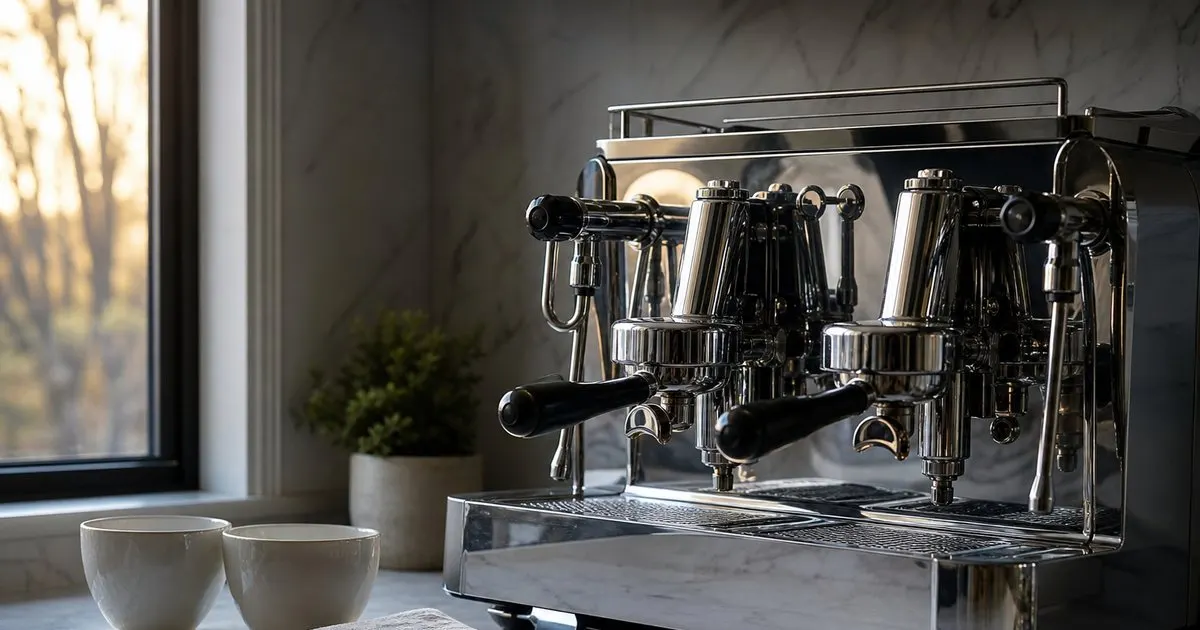
Why warm-up takes so long on heavy machines
The mass that makes a prosumer machine stable is exactly what makes it slow to heat. A brass or stainless boiler holding well over a liter of water, a heavy chromed group, and a thick drip tray all need to reach equilibrium before the first shot tastes right. Reaching set temperature on the display typically takes ten to twenty minutes, but the group head and portafilter lag behind, and most owners find that shots pulled before thirty to forty five minutes run cooler and thinner than those pulled later. Related: What actually separates a prosumer espresso machine from an everyday home model?
Machines with saturated groups or electrically heated group heads shorten that window considerably, and some newer designs with smaller, well insulated boilers are ready in a fraction of the time. When you compare candidates, ask specifically how long until the group is at temperature rather than how long until the boiler indicator light goes off. The honest number for a classic thermosyphon design is usually longer than the brochure implies.
Keep reading: What actually separates a prosumer espresso machine from an everyday home model?, How important is a dual boiler when choosing a luxury espresso machine?, Should you pair your espresso machine with a separate high end grinder?. See how Cremaholm helps you a connoisseur guide to prosumer and luxury espresso machines.
What continuous heating actually costs
Once at temperature, a well insulated machine only draws power to replace the heat it loses, so idle consumption is far lower than the rated wattage. Still, a large dual boiler kept hot around the clock consumes a meaningful amount of electricity over a year, and the exact figure depends on boiler size, insulation, ambient temperature, and your utility rate. It is worth measuring with an inexpensive plug-in energy meter for a week rather than guessing. Related: How important is a dual boiler when choosing a luxury espresso machine?
Beyond the bill, continuous heating keeps the heating elements and the pressurestat or PID relays cycling constantly. That wear is gradual and rarely dramatic, but a machine left hot for years will typically need element or relay attention sooner than one that runs eight hours a day. Scale also forms as water is heated and evaporates, so an always on steam boiler fed untreated water accumulates deposits faster. Related: How do you plan plumbing and water treatment for a luxury espresso setup?
Timers, eco modes, and smart plugs
The most elegant compromise is a schedule. Many premium machines now include an onboard timer or a companion app that heats the machine before you wake and drops it to standby after the morning rush. Eco or standby modes typically lower the boiler setpoints rather than switching off entirely, which means recovery to full temperature takes minutes rather than the better part of an hour. If your machine offers one, it is the feature to use.
For machines without a built-in timer, a smart plug works only if the power switch is a mechanical rocker that stays in the on position. Machines with a soft touch electronic power button will remain off when the plug restores power, unless the manufacturer offers an auto on setting. Confirm this before relying on it, and make sure the plug is rated for the machine's full draw, not just its idle consumption. Related: Should you pair your espresso machine with a separate high end grinder?
A practical routine for real households
If you pull shots at several points in the day, from a morning cappuccino to an afternoon espresso and an evening decaf, leaving the machine on from early morning to mid evening makes sense and an overnight standby covers the rest. If you only drink coffee before work, a timer that warms the machine an hour before you rise and switches it to standby by mid morning captures nearly all of the convenience at a fraction of the energy.
Machines with fast heating groups change the calculation entirely and can be switched on when you walk into the kitchen. Whatever you choose, avoid the habit of switching a large boiler machine on and off multiple times a day; the repeated full heat cycles are harder on components than a steady idle, and you will spend most of your coffee time waiting.
- Boiler indicator lights flatter the machine; the group and portafilter need thirty to forty five minutes on many classic designs.
- Idle power draw is modest per hour but adds up over a year, so measure it with a plug-in meter.
- Onboard timers and standby modes deliver most of the convenience of always on with far less heat and wear.
- Smart plugs only work with mechanical power switches or a built-in auto on setting.

Julien Jimenez
Julien Jimenez is an independent software builder based in Paris. He designs, ships, and operates focused SaaS products for small businesses and independent professionals. Read the full author page.
Cafe-Grade Espresso, At Home
A connoisseur guide to prosumer and luxury espresso machines. Cremaholm is built to help you put this into practice.
Find your machineMore from the Cremaholm blog
Get the complete espresso machines guide
Our full buying guide, the price guide, and new research as we publish it. One email, no spam, unsubscribe any time.